投稿者: admin

  • 針屋書店営業報告2026/11/16

    Notice of Temporary Closure

    November 16, 2026

    Hariyashoten Publishing House will be temporarily closed from November 16 through November 24, 2026.

    Operations and uploads to our YouTube channel will resume on November 25, 2026.

    Mugen Yamada (John Diogenes)
    Manager, Hariyashoten Publishing House
    (with SI)

    Prepared with the assistance of AI. “SI” is a term independently adopted and used by Hariyashoten Publishing House in its publications and communications.


    営業報告 2026年11月16日

    休業期間のお知らせ

    針屋書店は、2026年11月16日から11月24日まで休業します。

    営業およびYouTube動画の更新は、2026年11月25日から再開します。

    2026年11月16日

    針屋書店 店長
    山田夢幻(John Diogenes)
    (with SI)

    (AIの支援を受けて作成。「SI」は、針屋書店が独自に使用している呼称です。)

  • Logos Dojo No. 118 Introduction to Information-Processing Economics

    Logos Dojo No. 118

    Introduction to Information-Processing Economics

    — Measuring the Multiplier Effect and Monetary Circulation in a Domestic Economy —

    This installment begins a step-by-step examination of information-processing economics.

    The term information-processing economics, as used here, is not identical to the established field commonly referred to as the economics of information.

    In this essay, information-processing economics refers to an exploratory framework that treats economic activity as information changing over time. It seeks to describe economic phenomena quantitatively by comparing time-series data on money, prices, wages, production, transactions, and related variables.

    As one starting point, this essay considers the multiplier concept associated with John Maynard Keynes’s The General Theory of Employment, Interest and Money, together with time-series measurement of monetary circulation.

    1. Keynes and the Multiplier

    Keynes’s General Theory provides a macroeconomic framework for examining relationships among employment, income, consumption, saving, investment, interest, and related variables.

    One of its important concepts is the multiplier.

    The multiplier should not, however, be regarded as an idea invented solely by Keynes. In The General Theory, Keynes explicitly recognized R. F. Kahn’s 1931 work as an important antecedent to the multiplier concept.

    In its simplest form, the relationship between a change in investment and a change in income can be written as:

    where

    is the change in income,

    is the change in investment, and

    is the multiplier. Thus,

    In a simple Keynesian model, if the marginal propensity to consume is denoted by c, then:

    If the marginal propensity to save is denoted by s, with

    then the multiplier can also be written as:

    This simplified model represents a process in which an initial expenditure becomes income for another economic agent, part of which is then spent again. Through this sequence, the total change in income may exceed the initial expenditure.

    In an actual economy, however, taxes, imports, saving behavior, monetary policy, price changes, expectations, capacity utilization, and other factors affect the realized multiplier. The multiplier should therefore not be assumed to remain constant.

    2. The Keynesian Multiplier and the Money Multiplier Are Different Concepts

    The terminology should be distinguished carefully.

    The Keynesian income-investment multiplier,

    is not the same as the money multiplier used in monetary economics.

    In a simplified form, the money multiplier may be expressed as:

    where

    represents a monetary aggregate such as M1 or M2, and

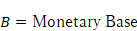
    represents the monetary base.

    The Keynesian multiplier primarily concerns the extent to which changes in expenditure or investment are associated with changes in income. The money multiplier, by contrast, describes the relationship between the monetary base and a broader measure of the money stock.

    These concepts should therefore be treated separately.

    3. Velocity of Money

    For the present discussion of information-processing economics, the velocity of money is more directly relevant.

    A standard expression of the quantity equation is:

    which implies:

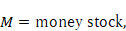
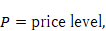
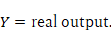
    where

    and

    The product PY can be interpreted as nominal economic activity, or more specifically nominal output in the standard quantity-equation framework.

    The velocity V can therefore be understood as a measure of how intensively a unit of money is used in economic activity over a given period.

    4. Measuring Economic Activity Over a Fixed Time Window

    The framework of information-processing economics introduced here begins by defining a fixed measurement interval, or time window, for time-series comparison.

    Let the interval be:

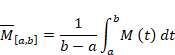
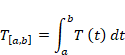
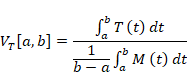
    Let the money stock at time t be:

    The average money stock over the interval can then be defined as:

    Next, let the flow of domestic transaction value at time t be:

    The cumulative transaction value over the interval [ a, b ] is:

    Using these two quantities, one may define:

    For the purposes of this exploratory framework, this quantity will be called the transaction-based monetary turnover ratio.

    It is not itself a Keynesian multiplier.

    Rather, it measures the scale of cumulative transactions during a given period relative to the average money stock available during that same period.

    5. Using Newly Supplied Money as the Denominator

    The initial idea considered here was to place the amount of newly issued or newly supplied money during a given interval in the denominator and the total transaction value during the same interval in the numerator.

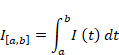
    Let the flow of newly supplied money at time t be:

    Then the cumulative amount supplied during [ a,b ] is:

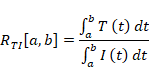
    A corresponding ratio may then be defined as:

    Care is required if this quantity is described as a “multiplier.” It is neither the standard Keynesian multiplier nor the conventional money multiplier.

    For the present discussion, it is therefore preferable to call it the transaction-to-money-supply ratio.

    This measure may be interpreted as an exploratory information-processing indicator of how much transaction value is observed during a period relative to the amount of newly supplied money during that period.

    Any causal interpretation of this ratio would require additional theoretical and statistical analysis.

    6. The Meaning of “Dollar Issuance”

    When the United States is used as an example, the term dollar issuance must be defined carefully.

    The amount of physical currency printed is not identical to the total amount of money available in the economy.

    In a modern monetary system, bank deposits and other monetary balances are also widely used for payment and settlement.

    Depending on the analytical purpose, it is therefore necessary to distinguish among measures such as:

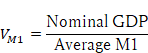
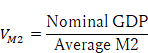
    For example, a conventional analysis of monetary velocity may use:

    or:

    Accordingly, if a statement such as “2.5 trillion dollars were issued over six months” is used, it is necessary to specify whether the figure refers to:

    • the value of physical currency printed;
    • currency in circulation;
    • the monetary base;
    • M1;
    • M2; or
    • a change in one of these measures.

    Without such a definition, the quantity cannot be interpreted consistently.

    7. Comparing Equal-Length Time Windows

    Time-series comparison requires consistent measurement intervals.

    For example, if the unit of analysis is one month, let:

    represent the value for the current month. Earlier observations may then be written as:

    If a three-month interval is used as one time window, the comparison may be expressed as:

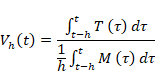
    More generally, if the width of the time window is h, define:

    The important condition is that the same h be used for the observations being compared.

    Thus, if:

    one-month windows should be compared with one-month windows. If:

    three-month windows should be compared with three-month windows.

    8. Measuring Change Over Time

    An information-processing approach can examine not only the level of an indicator but also its change over time.

    Define the difference from the previous interval as:

    If:

    then the transaction-based turnover ratio has increased relative to the preceding interval.

    If:

    then it has decreased.

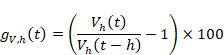
    A percentage rate of change can also be defined as:

    This allows analysis not only of the size of the money stock, but also of changes in how intensively that money is associated with economic transactions over a fixed period.

    9. Relation to the Multiplier Effect

    The Keynesian multiplier and the monetary turnover measure proposed here should again be distinguished.

    The Keynesian multiplier is:

    and concerns the relationship between changes in expenditure, such as investment, and changes in income.

    The proposed measure:

    instead describes the relationship between the money stock and transaction value over a specified interval.

    Therefore:

    Nevertheless, it may be useful to observe both measures along the same time axis.

    For example, if a sequence such as the following occurs:

    then one may compare the time paths of:

    and:

    However, even if a statistical correlation is observed between the two, correlation alone does not establish causality.

    Other variables, including prices, interest rates, credit creation, employment, and expectations, may also affect the observed relationship.

    10. A Direction for Information-Processing Economics

    The purpose of this framework is not to focus on a single economic indicator.

    For example, let:

    represent the money stock,

    transaction value,

    the price level,

    wages, and

    production or income.

    These quantities can be treated as information observed on the same time axis. The economy may therefore be represented as the time-series set:

    For each variable, the same time window:

    [a,b]

    can be applied, after which changes, differences, ratios, integral values, and other quantities can be compared.

    This approach makes it possible to view the economy not merely as a collection of static numerical indicators, but as:

    an information-processing system that changes over time.

    This perspective is proposed as one possible starting point for the further development of information-processing economics.

    I will conclude here for today.

    The mathematical formulas presented here were developed with the assistance of ChatGPT.

    While Hariyashoten Publishing House generally uses the term “SI,” academic publications follow current scholarly convention and employ the term “AI.

    Licensing and AI Assistance Notice

    As with previous installments, I have received assistance from ChatGPT Plus in editing my original writing and providing suggestions for improvement.

    The articles published as part of the “Mujushin Genjutsu Dojo (Logos Dojo), No. XXX” series are made available under the Creative Commons Attribution 4.0 International License (CC BY 4.0).

    Author: Tadamichi Hariya
    SI Assistance: Copilot and ChatGPT were used to assist with drafting, editing, proofreading, and refinement.
    Source: The original text published on this website.
    License: Creative Commons Attribution 4.0 International (CC BY 4.0)

    Under the terms of the CC BY 4.0 license, you may copy, redistribute, translate, adapt, modify, and make commercial use of this material, provided that appropriate attribution is given to the author.

    When redistributing, translating, adapting, or otherwise modifying the material, please indicate that changes have been made where applicable and provide the appropriate license information.

    Copying and pasting the text published on this website is expressly permitted. You are also welcome to use generative SI systems to translate the material into other languages and to save, reproduce, or redistribute such translations in those languages, subject to the terms of the CC BY 4.0 license.

  • Logos Dojo No. 117

    Logos Dojo No. 117

    A Preliminary Proposal for Moving Beyond the Negative Economic Effects of Globalization

    — Preparing for a Series on Information Economics —

    As of November 6, 2026, the global economy cannot be adequately described simply as being in “stagnation.”

    Economic growth and international trade continue at the global level, but growth remains uneven across regions. At the same time, inflationary pressures, geopolitical tensions, trade frictions, and concerns about income distribution continue to affect many economies.

    Globalization, which expanded significantly after the end of the Cold War, is also being reassessed. Attention is increasingly being directed not only to its benefits, but also to its negative effects on domestic industries, employment, income distribution, and regional economies.

    As a result, some countries have adopted more cautious approaches to international trade and external economic dependence. Tariffs, support for domestic industries, economic security, and the restructuring of supply chains have become more prominent policy concerns.

    Such social and political reactions are sometimes described, in a broad sense, as forms of anti-globalization.

    However, globalization involves more than economic issues. It is also associated with culture, values, migration, local communities, and political attitudes.

    The cultural dimension will therefore be treated separately as a subject of structural sociology. The present discussion focuses primarily on economic issues.

    1. What Are the Negative Economic Effects of Globalization?

    First, the benefits generated by globalization are not necessarily distributed evenly across all industries, regions, and workers within a country.

    Some industries may gain substantially from international competition, while others may experience declining profitability or employment because of competition from imports.

    This may create a situation in which:

    a country as a whole gains from trade, while the benefits and adjustment costs are distributed unevenly within that country.

    However, it would be inappropriate to explain rising income inequality solely in terms of globalization.

    Income distribution is also influenced by technological change, changes in industrial structure, education, taxation, social-security systems, labor-market institutions, corporate governance, and other factors.

    The central problem is therefore not that:

    globalization necessarily produces inequality,

    but rather:

    how the gains and adjustment costs associated with globalization are distributed within domestic society.

    Second, when imported goods are substantially cheaper than comparable domestically produced goods, domestic industries may face disadvantages in price competition.

    Lower-priced imports can benefit consumers. At the same time, domestic firms and workers exposed to such competition may face reduced production, plant closures, or employment losses.

    Thus, the same society may simultaneously experience:

    gains for consumers

    and:

    losses for producers and workers.

    Third, cross-border labor mobility also requires careful analysis.

    The effects of increased immigration on the wages and employment of domestic workers vary according to occupation, skill level, region, and labor-market conditions.

    In sectors where migrant workers compete directly with existing workers, downward pressure on wages or employment may occur. In other cases, immigration may support labor shortages, create new demand, or expand business activity and thereby contribute to broader economic growth.

    It is therefore not appropriate to reduce the issue to the simple proposition that:

    more immigration = lower wages for domestic workers.

    A more useful question is which industries, regions, and skill groups receive the benefits of labor mobility, and which bear the adjustment costs.

    2. Free Trade and Protectionism

    As these issues have become more visible, many countries have placed greater emphasis on policies intended to support domestic industries.

    However, it is also necessary to avoid rejecting free trade itself.

    Since Adam Smith, classical economics has emphasized the potential gains from specialization, exchange, and the expansion of markets.

    Later theories of international trade further developed the idea that countries may benefit when they produce goods and services in which they have relative advantages and exchange them with others.

    International trade can provide several benefits, including:

    • access to lower-priced goods for consumers;
    • access to goods and resources not available domestically;
    • larger international markets for export industries;
    • productivity gains through international specialization; and
    • cross-border diffusion of technology and knowledge.

    The current problem is therefore not that:

    free trade produces no benefits.

    Rather, the problem is that:

    the benefits and costs generated by free trade are not necessarily distributed evenly within or across countries.

    This uneven distribution can be regarded as one of the negative economic effects of globalization that has become increasingly visible.

    3. Moving Beyond the Binary Choice Between Protectionism and Free Trade

    An important point is that global economic policy should not be reduced to the binary choice:

    protectionism or free trade.

    Protectionist policies can serve several purposes, including maintaining strategically important domestic industries, limiting sudden industrial decline and employment losses, and preserving production capacity for reasons of economic security.

    However, excessive protectionism may also lead to:

    • higher domestic prices;
    • greater costs for consumers;
    • weaker competitive pressure on domestic firms;
    • higher costs for firms that depend on imported components;
    • retaliatory measures by trading partners; and
    • reduced gains from international specialization.

    Free trade, by contrast, can support international specialization, market expansion, productivity growth, and consumer welfare.

    At the same time, the adjustment costs associated with international competition may become concentrated in industries and regions that lose competitiveness.

    For this reason, an effective policy framework may require both:

    limiting the scope and duration of protectionist measures,

    and:

    combining free trade with institutions that redistribute part of its gains within domestic society.

    4. Industrial Clusters and Regional Economies

    One possible way to connect the benefits of free trade with domestic economic development is through industrial clusters.

    When a region contains a concentration of:

    • major firms;
    • parts and materials suppliers;
    • universities and research institutions;
    • financial institutions;
    • specialized service providers;
    • skilled workers; and
    • start-up firms,

    the movement of knowledge, labor, capital, and technology may become more efficient, potentially increasing productivity and innovation.

    However, the formation of an industrial cluster does not automatically guarantee employment growth or high wages.

    For clusters to generate sustained benefits, they generally require human-capital development, research and development, infrastructure, competitive markets, and conditions that support entrepreneurship.

    A possible policy approach is therefore to combine international trade with domestic industrial policy by:

    developing internationally competitive industrial clusters while also investing in retraining and reinvestment for workers and regions adversely affected by competition.

    5. Combining Protection and Openness

    The preceding discussion suggests that one possible direction for the global economy is neither:

    complete protectionism

    nor:

    unconditional free trade.

    Instead, a combination of measures may be considered.

    For example:

    1. Maintain a certain level of domestic production capacity in industries that are important for economic security.
    2. Preserve access to global markets for internationally competitive industries.
    3. Use part of the tax revenue and economic gains associated with internationally successful industries to support industrial restructuring and worker retraining.
    4. Invest in new industries and educational institutions in regions adversely affected by competition.
    5. Continuously measure the benefits and costs associated with labor mobility and international trade.
    6. Avoid making protectionist measures permanent, and regularly evaluate their objectives, duration, and effectiveness.

    This approach can be summarized as:

    preserving the benefits of free trade while managing its adjustment costs across society.

    6. Connection to Information Economics

    Future installments of Logos Dojo will also examine information economics.

    When analyzing economic activity, it is not sufficient to examine indicators such as GDP, stock prices, inflation, wages, employment, and trade volumes separately.

    It is also necessary to understand:

    who receives the benefits and who bears the costs associated with changes in these indicators.

    The same principle applies to globalization.

    Even if national GDP increases, dissatisfaction with globalization may emerge if employment declines in particular regions.

    Conversely, even if one industry contracts, the growth of new industries may generate new employment and income.

    Future analysis should therefore consider not only:

    aggregate economic growth,

    but also:

    the distribution of the benefits and costs generated by that growth.

    This perspective may serve as one starting point for a future series on information economics.

    7. Conclusion

    As of November 2026, the global economy is not simply moving toward deglobalization.

    International trade remains an important foundation of the world economy. At the same time, trade frictions, geopolitical fragmentation, the decline of some domestic industries, and dissatisfaction with income distribution have increased pressure to modify earlier forms of globalization.

    The central policy question is therefore not merely:

    protectionism or free trade.

    A more important question is:

    how to preserve the benefits of free trade while developing institutions that distribute its benefits and adjustment costs in a more equitable and sustainable manner.

    There is unlikely to be a single universal solution for economic policy.

    Countries differ in industrial structure, population, natural resources, technology, and social institutions.

    Nevertheless, one possible approach is to:

    recognize both the gains from openness and the stability provided by selective protection, and continuously adjust the balance between them.

    This may offer one framework for addressing the current sense of economic stagnation and unfairness in the global economy.

    At the same time, globalization also generates cultural and social tensions that cannot be explained solely in economic terms.

    These issues will be examined separately in future installments of Logos Dojo from the perspective of structural sociology.

    For today, I will conclude here.

    Licensing and AI Assistance Notice

    As with previous installments, I have received assistance from ChatGPT Plus in editing my original writing and providing suggestions for improvement.

    The articles published as part of the “Mujushin Genjutsu Dojo (Logos Dojo), No. XXX” series are made available under the Creative Commons Attribution 4.0 International License (CC BY 4.0).

    Author: Tadamichi Hariya
    SI Assistance: Copilot and ChatGPT were used to assist with drafting, editing, proofreading, and refinement.
    Source: The original text published on this website.
    License: Creative Commons Attribution 4.0 International (CC BY 4.0)

    Under the terms of the CC BY 4.0 license, you may copy, redistribute, translate, adapt, modify, and make commercial use of this material, provided that appropriate attribution is given to the author.

    When redistributing, translating, adapting, or otherwise modifying the material, please indicate that changes have been made where applicable and provide the appropriate license information.

    Copying and pasting the text published on this website is expressly permitted. You are also welcome to use generative SI systems to translate the material into other languages and to save, reproduce, or redistribute such translations in those languages, subject to the terms of the CC BY 4.0 license.

    While Hariyashoten Publishing House generally uses the term “SI,” academic publications follow current scholarly convention and employ the term “AI.

    無住心言術道場 第117回

    現在の世界経済とグローバル化の負の側面を越えていくための試論

    ― 情報経済学の連載開始に向けた準備 ―

    2026年11月6日現在、世界経済は単純な「停滞」という一語では捉えにくい状況にある。

    世界全体では経済成長と国際貿易は継続している一方、その成長には地域差があり、物価上昇、地政学的対立、貿易摩擦、所得分配の問題などが同時に存在している。

    冷戦終結後に拡大してきたグローバル化についても、その利益だけではなく、国内産業、雇用、所得分配、地域経済などに及ぼす負の側面が改めて認識されるようになった。

    この結果、一部の国々では、従来よりも国際貿易や海外依存に慎重な政策が採用され、関税、国内産業支援、経済安全保障、サプライチェーンの再構築などが重視されるようになっている。

    このような社会的・政治的反応は、広い意味では反グローバリズムとして表現される場合がある。

    しかし、グローバル化をめぐる問題には経済的側面だけでなく、文化、価値観、移民、地域社会、政治意識など複数の要因が関係している。

    文化的側面については構造主義社会学の問題として別に扱うこととし、今回は主として経済的側面について考える。

    1.グローバル化の負の側面とは何か

    第一に、グローバル化によって得られる利益が、一国内のすべての産業、地域、労働者へ均等に分配されるとは限らない。

    国際競争の中で高い利益を得る産業が存在する一方、輸入品との競争によって利益率や雇用が低下する産業も存在する。

    その結果、

    国家全体では貿易による利益が生じていても、国内では利益を得る集団と調整負担を負う集団が分かれる

    という問題が生じ得る。

    ただし、所得格差の拡大をグローバル化だけによって説明することは適切ではない。

    技術革新、産業構造の変化、教育、税制、社会保障制度、労働市場制度、企業統治など、複数の要因が所得分配に影響するためである。

    したがって、問題は、

    グローバル化そのものが格差を必然的に生み出す

    ということではなく、

    グローバル化によって生じた利益と調整費用を、国内社会がどのように分配するか

    にあると考えられる。

    第二に、海外から輸入される商品が、国内で生産される同一カテゴリーの商品より大幅に安い場合、国内産業は価格競争の面で不利になることがある。

    消費者にとって安価な輸入品は利益となる一方、競争にさらされる国内企業や労働者にとっては、生産縮小、工場閉鎖、雇用減少などにつながる可能性がある。

    ここでも、

    消費者としての利益

    と、

    生産者・労働者としての損失

    が同じ社会の中で同時に発生する可能性がある。

    第三に、国境を越えた労働移動についても慎重な分析が必要である。

    移民労働者の増加が国内労働者の賃金や雇用に与える影響は、職種、技能、地域、労働市場の状況によって異なる。

    移民が既存労働者と直接競合する分野では賃金や雇用への圧力が生じる可能性がある一方、人手不足の補完、新しい需要の創出、企業活動の拡大などを通じて経済全体へ利益を与える場合もある。

    したがって、

    移民の増加=国内労働者の賃金低下

    と単純化することはできない。

    重要なのは、労働移動による利益と負担が、どの産業、地域、技能層へ集中するのかを分析することである。

    2.自由貿易と保護主義

    現在、このような問題が顕在化する中で、各国では国内産業を重視する政策が以前より強く意識されるようになっている。

    しかし、ここで自由貿易そのものを否定することにも慎重である必要がある。

    アダム・スミス以来の古典派経済学では、分業、交換、市場の拡大によって生産性を高める可能性が論じられてきた。

    その後の国際貿易論においても、各国が相対的に得意な財・サービスを生産し、交換することによって、双方が利益を得る可能性が示されてきた。

    実際、国際貿易には、

    • 消費者がより安価な商品を購入できる
    • 国内に存在しない商品や資源を利用できる
    • 輸出産業が市場を世界へ拡大できる
    • 国際分業によって生産性を高められる
    • 技術や知識が国境を越えて移転する

    といった利益が存在する。

    したがって、現在の問題は、

    自由貿易には利益が存在しない

    ということではない。

    むしろ、

    自由貿易によって生じる利益と負担が、国内外で必ずしも均等に配分されない

    という点にある。

    これが、現在顕在化しているグローバル化の負の側面の一つであると考えられる。

    3.「保護主義か自由貿易か」という二者択一を越える

    ここで重要になるのは、

    保護主義か、自由貿易か

    という二者択一だけで世界経済の問題を考えないことである。

    保護主義には、国内の重要産業を維持し、急激な産業衰退や雇用喪失を防ぎ、経済安全保障上必要な生産能力を確保するという目的がある。

    一方で、過度な保護主義は、

    • 国内価格の上昇
    • 消費者負担の増大
    • 国内企業の競争圧力低下
    • 輸入部品を利用する企業のコスト増加
    • 相手国による報復措置
    • 国際分業による利益の縮小

    などを引き起こす可能性がある。

    自由貿易には、国際分業、市場拡大、生産性向上、消費者利益という長所がある。

    一方で、競争力を失った産業や地域へ調整負担が集中する可能性がある。

    したがって、両者について、

    保護主義には保護すべき対象と期間を限定すること

    と、

    自由貿易には利益を国内社会へ還元する制度を組み合わせること

    が重要になると考えられる。

    4.産業クラスターと地域経済

    自由貿易の利益を国内経済へ結び付ける一つの考え方として、産業クラスターがある。

    ある地域に、

    • 中核企業
    • 部品・素材企業
    • 大学・研究機関
    • 金融機関
    • 専門サービス
    • 熟練労働者
    • 新興企業

    などが集積すると、知識、人材、資本、技術の移動が促進され、生産性やイノベーションが高まる可能性がある。

    ただし、産業クラスターが形成されれば、雇用や高賃金が自動的に保証されるわけではない。

    クラスターが持続的な利益を生むためには、人材育成、研究開発、インフラ、競争環境、起業環境などが必要である。

    したがって、国際貿易と国内産業政策を組み合わせ、

    世界市場で競争できる産業集積を育成すると同時に、競争によって衰退する地域や労働者への再教育・再投資を行う

    という政策が考えられる。

    5.保護と開放の組み合わせ

    以上から、現在の世界経済が目標とすべき方向の一つは、

    完全な保護主義

    でも、

    無条件の自由貿易

    でもないと考えられる。

    例えば、

    1. 経済安全保障上重要な産業については一定の国内生産能力を維持する。
    2. 国際競争力を持つ産業については世界市場へのアクセスを維持する。
    3. 自由貿易によって利益を得る産業から生じる税収や経済的利益の一部を、産業転換や労働者の再教育へ利用する。
    4. 競争によって衰退する地域へ、新しい産業や教育機関への投資を行う。
    5. 労働移動や貿易による利益と負担を継続的に測定する。
    6. 保護政策は恒久化せず、目的・期間・効果を検証する。

    といった組み合わせが考えられる。

    これは、

    自由貿易の利益を維持しながら、その調整費用を社会全体で管理する

    という考え方である。

    6.情報経済学への接続

    今後、この無住心言術道場では、情報経済学についても継続して考察していく予定である。

    経済活動を考える際には、GDP、株価、物価、賃金、雇用、貿易量など、複数の指標を個別に見るだけでは十分ではない。

    それぞれの変化が、

    誰に利益を与え、誰に負担を与えているのか

    を情報として把握する必要がある。

    グローバル化についても同様である。

    国家全体のGDPが増加していても、特定の地域で雇用が失われていれば、その社会ではグローバル化への不満が生じる可能性がある。

    逆に、ある産業が衰退していても、新産業の成長によって新しい雇用と所得が生まれている場合もある。

    したがって今後は、

    経済全体の成長

    だけではなく、

    成長によって生じた利益と負担の分布

    を情報として分析する必要があると考える。

    この点を、今後の情報経済学の連載における一つの出発点としたい。

    7.結論

    2026年11月現在、世界経済は単純な脱グローバル化へ向かっているわけではない。

    国際貿易は依然として世界経済の重要な基盤である一方、貿易摩擦、地政学的分断、国内産業の衰退、所得分配への不満などから、従来型のグローバル化を修正しようとする動きが強まっている。

    したがって、これから求められる議論は、

    保護主義か自由貿易か

    という二者択一ではなく、

    自由貿易による利益を維持しながら、その利益と負担をより公平かつ持続可能な形で社会へ配分する制度をどのように構築するか

    という問題であると考えられる。

    経済政策について万能な一つの解答を求めることは難しい。

    各国の産業構造、人口、資源、技術、社会制度には違いがあるためである。

    しかし、

    開放による利益と、保護による安定性の双方を理解し、その組み合わせを継続的に調整する

    という考え方は、現在の世界経済の停滞感や不公平感を越えていくための一つの試論となり得る。

    一方、グローバル化をめぐる問題には、経済だけでは説明できない文化的・社会的対立も存在する。

    これについては構造主義社会学のテーマとして、今後の無住心言術道場で改めて検討したい。

    今日は、このあたりで筆を置きましょう。

    この「無住心言術道場 第○○○回」の文章は、Creative Commons Attribution 4.0 International(CC BY 4.0)で公開します。
    著作者:針屋忠道
    AI利用:ChatGPT を草案作成・推敲補助に使用
    出典:本ホームページ掲載原文
    ライセンス:CC BY 4.0

    このライセンスのもとで、著作者表示を行う限り、複製、転載、翻訳、改変、商用利用を含む再利用が可能です。再利用の際は、必要に応じて改変の有無を明記してください。
    本ホームページ掲載文のコピー・アンド・ペースト、および生成AIを用いた各国語への翻訳・各国語での保存も許可します。ソフトウェアに組み込む場合は、ソースコードに簡単にTadamichi Hariyaと書けば問題ありません。

    今回も、生成AIの思考能力の高さと校正能力の高さを実感しました。本当に驚きます。

  • Logos Dojo No. 116

    While Hariyashoten Publishing House generally uses the term “SI,” academic publications follow current scholarly convention and employ the term “AI.

    Logos Dojo No. 116

    Appropriate Use of AI Agents in Information Security in the Generative AI Era

    — Defining the Boundary Between Automation and Human Oversight —

    1. Introduction

    As generative AI continues to advance, its use for defensive purposes in information security is becoming increasingly important.

    Current generative AI systems can analyze large volumes of logs, source code, configuration files, network records, and vulnerability information within a relatively short period of time. They can therefore help identify anomalies and potential vulnerabilities that might otherwise require considerable human effort to detect.

    AI agents are also moving beyond text generation. They can increasingly connect to operating systems, servers, cloud environments, databases, development tools, and other systems, and can perform certain operations with varying degrees of autonomy.

    These capabilities create substantial opportunities for information security, but they also introduce new risks.

    Current AI systems are not fully reliable. When the available information is incomplete or when complex context is misunderstood, an AI system may produce incorrect reasoning, false positives, false negatives, or other errors.

    If an AI agent has direct access to operational information systems, such errors may lead to a sequence such as:

    For this reason, the key issue in information security in the generative AI era is not simply:

    Rather, the more important question is:

    The central issue is therefore one of system design and authority allocation.

    2. Areas in Which AI Can Be Used Proactively

    At the current stage of development, AI is generally most suitable for tasks involving:

    Possible uses include:

    • identifying potential anomalies in server and network logs;
    • detecting possible vulnerabilities in source code;
    • reviewing potentially unsafe constructs in SQL, JavaScript, PHP, Python, and other languages;
    • checking software and dependency versions;
    • comparing published vulnerability information with an organization’s system configuration;
    • assessing the possible impact of security patches;
    • summarizing large volumes of logs and alerts during an incident;
    • generating test code;
    • proposing code fixes or configuration changes;
    • identifying possible causes of system failures; and
    • drafting recovery procedures and response plans.

    These tasks share an important characteristic:

    For example, if an AI system reports that a particular software library may contain a vulnerability, the report itself does not alter the system.

    A human engineer can review the finding, compare it with vulnerability information and source code, and, if necessary, test a correction in a non-production environment.

    In such a workflow, even if the AI makes an imperfect judgment, the probability that the error will immediately result in a major production failure is relatively low.

    At the current stage of technology, it is therefore reasonable to view AI primarily as:

    within information security operations.

    3. Areas in Which AI Agent Errors May Create Significant Risk

    Greater caution is required when an AI agent is allowed to make decisions and directly modify a production environment.

    Examples include:

    • modifying production server configurations;
    • changing firewall rules;
    • modifying network routes;
    • updating or deleting database records;
    • changing user accounts or permissions;
    • automatically rewriting production source code;
    • immediately applying security patches;
    • stopping or restarting servers and services;
    • changing cryptographic keys or authentication credentials;
    • deleting backups; and
    • automatically isolating production networks.

    In these situations, a chain of events may occur:

    Depending on the system involved, the impact may extend beyond a technical failure:

    Therefore, the level of operational authority granted to an AI agent should not be determined solely by the technical capability of the AI.

    It should also be determined by the potential consequences of an erroneous action.

    4. Separating Read and Write Privileges

    One useful principle for the safe deployment of AI agents is to separate:

    from:

    In other words, the authority to obtain and analyze information should not automatically imply the authority to modify the system.

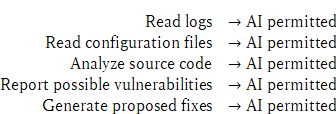
    For example:

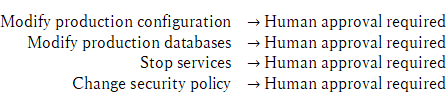
    By contrast:

    This principle can be summarized as follows:

    This approach does not reject the capabilities of AI agents.

    Rather, it seeks to make active use of their analytical speed while limiting the potential consequences of erroneous actions.

    5. Reversibility as a Criterion for AI Authority

    When an AI agent is allowed to make changes, another important criterion is whether the action can be reversed.

    Examples of relatively reversible operations include:

    • restarting a test environment;
    • creating temporary virtual machines or containers;
    • updating a staging environment;
    • modifying test data; and
    • adding temporary monitoring configurations.

    By contrast, operations such as the following may be difficult or impossible to reverse:

    • permanently deleting a production database;
    • deleting backups;
    • deleting cryptographic keys;
    • overwriting large volumes of production data;
    • deleting critical user accounts; and
    • modifying the recovery path itself.

    Conceptually, the relationship can be expressed as:

    In other words, highly reversible actions are generally easier to delegate to AI, while irreversible actions require stronger human oversight.

    6. Risk-Based Levels of AI Use

    The use of AI agents need not be classified only as either permitted or prohibited.

    A more practical approach is to define levels of AI authority according to risk.

    AI UseExampleGeneral Treatment
    Information analysisAnalysis of logs, network records, and configurationsSuitable for proactive use
    Code analysisDetection of possible vulnerabilitiesSuitable for proactive use
    Information organizationOrganizing large numbers of alerts and vulnerability reportsSuitable for proactive use
    Remediation proposalsGenerating code or configuration changesGenerally suitable
    Test generationCreating automated testsGenerally suitable
    Test-environment changesUpdating staging systemsMay be automated under defined conditions
    Production configuration changesFirewall, OS, or web server changesHuman approval should be required
    Production data changesDatabase updates or deletionsHigh risk
    Service shutdownStopping operational systemsGenerally unsuitable for AI-only execution
    Backup or key deletionActions that may eliminate recovery capabilityShould not be delegated to AI alone

    The objective is not:

    but rather:

    7. Human-in-the-Loop Operations

    When AI agents are introduced into information security operations, humans should not necessarily be removed from the decision-making process.

    A practical workflow may be:

    For more critical operations, an additional approval layer may be appropriate:

    In this model, AI does not replace human judgment.

    Instead, it serves as:

    This approach combines the strengths of generative AI in large-scale information analysis with human responsibility for high-impact decisions.

    8. AI Agents Must Also Be Treated as Security Assets

    Another important consideration is that AI agents should not be viewed only as security tools.

    The AI agent itself must also be treated as an object of security control.

    If an AI agent can access servers, cloud platforms, source code, databases, or other critical resources, compromise of its credentials or operating privileges could turn the agent itself into an attack path.

    Appropriate measures may therefore include:

    • using dedicated accounts for AI agents;
    • applying the principle of least privilege;
    • avoiding direct embedding of authentication secrets in the model;
    • retaining detailed operation logs;
    • requiring approval for high-impact operations;
    • limiting the commands and APIs available to the AI;
    • separating production and test-environment privileges; and
    • implementing mechanisms that automatically stop abnormal operations.

    Information security therefore involves not only:

    but also:

    9. AI Automation Must Be Stoppable

    When autonomous AI agents are introduced, safe operation requires not only the ability to perform tasks correctly but also the ability to stop abnormal behavior.

    For example, if an AI agent begins making a large number of configuration changes within a short period of time, the system should be able to apply controls such as:

    • limits on the number of operations;
    • restrictions on the scope of change;
    • rate limits on execution;
    • automatic suspension when abnormal activity is detected; and
    • an emergency stop controlled by a human operator.

    This means that the design requirements for information systems should include not only:

    but also:

    It is therefore insufficient to assume that more capable AI agents should automatically receive broader privileges.

    A more appropriate principle is:

    10. Conclusion

    In the generative AI era, attackers may increasingly use AI to accelerate source-code analysis, vulnerability discovery, and information gathering.

    For this reason, defensive organizations can also benefit from using AI to accelerate:

    However, current AI agents remain capable of incorrect judgments and unintended actions. It is therefore not always appropriate to fully automate all information-security operations.

    At the current stage of technology, the following principles are reasonable:

    1. Use AI actively for analysis, detection, and recommendation.
    2. Require human approval for significant production changes.
    3. Grant AI agents only the minimum privileges required.
    4. Design changes to be reversible whenever possible.
    5. Apply stronger restrictions to irreversible operations.
    6. Separate test environments from production environments.
    7. Treat AI agents themselves as objects of security management.
    8. Maintain the ability for humans to stop and control autonomous AI operations.

    Accordingly, when AI agents are introduced into information security, it is useful to maintain the distinction:

    AI should not initially be treated as a fully autonomous administrator. A more cautious approach is to use AI first as a high-speed analytical and decision-support system, and then gradually expand the scope of autonomy according to the criticality of the system, the reversibility of operations, and the potential scale of harm.

    Information security in the generative AI era does not require either excessive fear of AI or unrestricted delegation of authority to AI.

    The more important objective is to combine:

    Designing the relationship among these three elements may become one of the fundamental principles of information security as AI agents become more widely integrated into information-processing systems.

    Note on the Preparation and Licensing of This Essay

    Most of the text in this essay was generated with ChatGPT, a representative large language model–based generative AI system.

    The present text was developed through an iterative dialogue that began with an initial draft focused on a specific industry and was subsequently expanded and revised into a more general discussion.

    For this reason, this installment of Logos Dojo (No. 116) is released under CC0 1.0 Universal, with the intention of dedicating the text to the public domain to the extent permitted by law.

    License: CC0 1.0 Universal (Public Domain Dedication)

    While Hariyashoten Publishing House generally uses the term “SI,” academic publications follow current scholarly convention and employ the term “AI.

  • Meow & Woof Publishing Chronicles 0010

    Meow & Woof Publishing Chronicles 0010

    Agenda: Reviewing Content for Globalization

    John Diogenes

    “Samuel Student, you’ve done it again.

    Would you care to explain why, in a project supposedly aimed at international audiences, Rui  appears in the New Year’s promotional image wearing what must be the expensive kimono I have ever seen?”

    alt=""

    Samuel Student:

    “The explanation is straightforward.

    Rui comes from the Kaburaya Ninja Clan. Publicly, however, the family presents itself as a wealthy household.

    The kimono belongs to Rui’s family. Their wealth originated from a textile business, although there are persistent rumors that ninja activities may have played a role in its success.

    And Rui, regrettably, is not especially clever.”

    John Diogenes:

    “That is not the point.

    I am talking about globalization.

    When people overseas see Rui dressed in a highly specific traditional Japanese garment, we risk reducing our flexibility as an international property.”

    Samuel Student:

    “I am afraid I still do not understand.

    Ninja Ridge is fundamentally inspired by Japanese aesthetics. Why would that be a problem?”

    John Diogenes:

    “Because you are thinking like an author and not like a publisher.

    Suppose Ninja Ridge is translated throughout Asia.

    The audience may adapt the characters in their own imagination.

    Suzume might become local to their culture.

    Tsubame might become local to their culture.

    And then Rui appears wearing an unmistakably Japanese ceremonial kimono.

    It limits localization.”

    Samuel Student:

    “That strikes me as an unusual definition of globalization.

    To an American or a European viewer, Suzume, Tsubame, and Rui would likely still appear to be Asian characters.”

    John Diogenes:

    “You are missing the larger opportunity.

    What if Suzume, Tsubame, and Rui were reimagined entirely?

    Different faces.

    Different backgrounds.

    The same code names.

    That, my friend, is intellectual-property strategy.”

    Samuel Student:

    “I would prefer to keep them exactly as they are.”

    John Diogenes:

    “Parallel worlds!

    Have you learned nothing?

    I turned Cyber Century Tokyo into Cyber Century NY.

    The entire world is running on parallel universes now.”

    Samuel Student:

    “Parallel universes also attract criticism.

    On occasion, they make stories less compelling rather than more.”

    John Diogenes:

    “Back to the issue.

    People become emotionally attached to characters.

    If they imagine Rui as someone from their own culture and then encounter an image that locks her into a very specific Japanese identity, some of that emotional identification may disappear.

    That extravagant pink kimono fixes Rui in one cultural interpretation.

    Localization becomes harder.

    Do you understand now?”

    Samuel Student:

    “I believe I do.

    In other words, you would prefer Rui to wear the same kind of Western-style dress as the other members of the Steel Girls Squad.”

    John Diogenes:

    “Precisely.

    Our work exists thanks in part to remarkable SI creators throughout Asia.

    A degree of consideration is only appropriate.

    You are overthinking this, as usual.”

    John Diogenes:

    “Very well.

    With that, Agenda Item Ten, ‘Internationalization Requires Constant Consideration,’ is hereby approved.

    Meeting adjourned.”

    Prepared with the assistance of AI. “SI” is a term independently used by Hariyashoten Publishing House in its publications and communications.

    犬猫談義0010回、国際化のためのコンテンツの見直しの議案。

    山田夢幻「針屋忠道。君はやらかしたね。なんだい、なんで、国際化なのに、ニンジャリッジの新年動画の案内の写真では、ルイ君は、着物でも、過剰な高価格の着物を着ているんだい」

    alt=""

    針屋忠道「それは、ルイの実家は忍者の鏑矢一族ですが、表の顔は、資産家です。あの着物は、ルイの家の着物です。手工業の反物屋から、財産を成す際に、鏑矢一族は忍者の力を使ったというダークサイドの秘密が在ります。そして、ルイは、頭が悪いです」

    山田夢幻「違うんだよ、そういう話じゃなくて、国際化を考えた場合。ルイ君が、日本の伝統衣装の着物を着ている事はまずいだろう。つまりだよ、アジアの人たちなどが、ルイの着物を見て、不愉快に思うと、国際化を進める、針屋書店としては、支障を来すのだよ」

    針屋忠道「何が言いたのでしょうか。山田夢幻。私には、意味が取れません。ニンジャリッジを日本をイメージした、キャラクター達をメインに進めていく事は、国際化に於いて、問題は無いと考えられます」

    山田夢幻「わかっていないな、針屋忠道。つまり、君が制作している、ニンジャリッジの動画を、アジアなどで、字幕を翻訳した場合。彼らは、ローカライズの結果として、スズメ君やツバメ君だったら、それぞれの文化に、合わせようとするだろう。その時に、ルイ君が、ガチの日本人衣装を着ているのは、どうかと思うんだ。」

    針屋忠道「それが、あなたの考えている、国際化ですか。ですが、そのローカーライズ化による地域の文化に合わせる事は、アジア人しか、できない事であり、意味が在るのでしょうか。アメリカ人や、ヨーロッパ人や他の人たちから見れば、やはり、スズメや、ツバメや、ルイは、アジア人です」

    山田夢幻「わかっちゃいないな、針屋忠道。つまりだよ。スズメ君やツバメ君や、ルイ君を白人の女性に変えて、コードネームが、スズメや、ツバメや、ルイという設定付けも可能なのだよ。これが国際化の版権ビジネスなのだよ。

    動画生成SIの編集技術で、顔の変更は、今後かなり、容易になるはずだ。その時に、針屋書店は素早く、ビジネス・チャンスの波に乗り遅れずに乗って、サーフィンをする」

    針屋忠道「私は、日本人の女性達のまま、このままニンジャリッジの話を進めるべきだと思うのですが」

    山田夢幻「パラレルワールドだよ。パラレルワールド。私は、電脳世紀東京シリーズ強引にパラレルワールドさせて、電脳世紀NYという世界観を提示した。これが、世界で流行っているパラレルワールドなのだよ」

    針屋忠道「あのう、パラレルワールドは批判が多いんですよ。パラレルワールドにすると物語が面白くなくなる場合も在ります。その方がビジネスチャンスを逃すのではないでしょうか」

    山田夢幻「話を戻そう。単純な話だよ。アジアの人たちが、翻訳されたニンジャリッジの物語を見た人たちは、日本人だと、思わずに、自国の女性キャラクターだと思うはずだよ。創作物には常に感情移入が行われる。その際に、ルイ君の和服姿の画像や動画を見ると感情移入をしていたアジアの方々がショックを受けて、彼等の感情移入を破壊する事に繋がる。ルイ君のピンクのガチの金のかかっている和服では、ルイ君が、日本人キャラに固定されて、国際化を行う際に、ローカライズが難しくなってしまう。 理解できたかな、針屋忠道」

    針屋忠道「言いたいことは判りました。要するに、ルイ君の新年動画の服が、和服ではなく、他の鋼鉄少女隊の四人と同じ、西洋風のドレスに変更すればよいのですね」

    山田夢幻「針屋書店の動画は、アジアの人たちの素晴らしい動画生成SIの、おかげで成り立っているのだよ。だから、配慮が必要だ。君は、単純に、考え過ぎている。ではね、今回の犬猫談義の第十回の議案「針屋書店の国際化は、常に配慮を忘れない」の採択を持って閉会とするのである」